
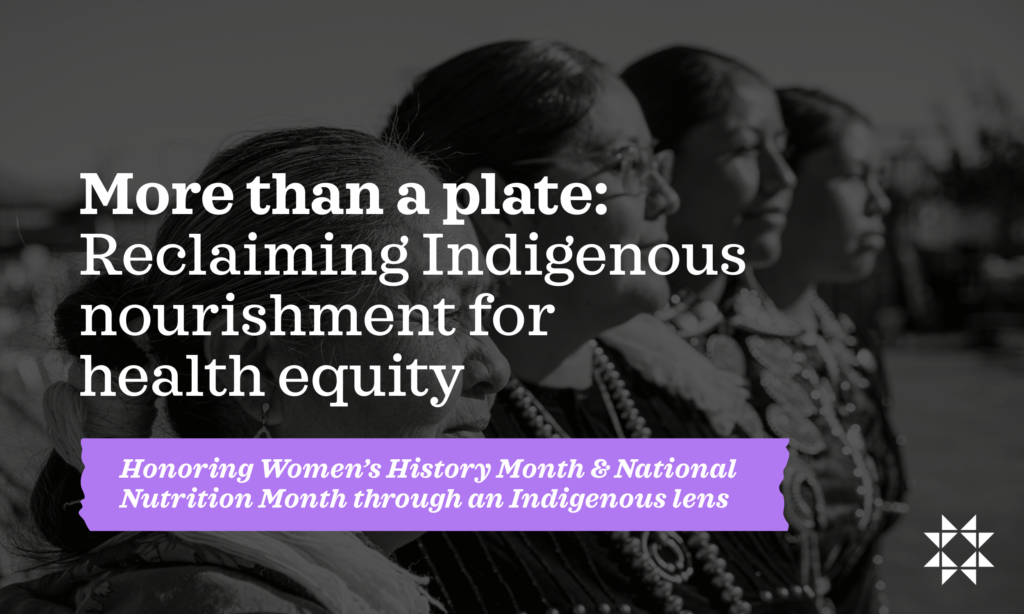

Honoring Women’s History Month & National Nutrition Month through an Indigenous lens
Every March, the conversation around nutrition fills up with the usual advice—calories, meal plans, the latest superfood. For Indigenous communities, nourishment has always been about something much bigger than what ends up on a plate.
This month is also Women’s History Month, and that intersection matters. The people who have carried food knowledge across generations—the seed keepers, the gatherers, the farmers who knew which plants to grow, how to help them thrive, and when to harvest—have overwhelmingly been Indigenous women.
The 2007 Declaration of the Forum for Food Sovereignty at Nyéléni, Mali, recognized that women play a central role in nourishing their families and communities worldwide. In Indian Country, this has always been true. American Indian and Alaska Native women have been critical stewards of food systems that sustained Nations for thousands of years.
So what if real nutrition is about the land your food came from, the hands that prepared it, and the generations of knowledge behind it?
Where Standard Nutrition Advice Falls Short
Mainstream nutrition conversations tend to focus on individual choices: eat this, avoid that. That framing misses food deserts, the legacy of colonization that disrupted traditional food systems, and the ongoing effects of historical trauma across Indian Country.
When the narrative around Native health focuses exclusively on disease rates and disparities, it reduces vibrant, sovereign Nations to statistics. Indigenous communities, and particularly Indigenous women, have been nourishing themselves and their relatives for millennia. Their strengths, knowledge systems, and self-determination deserve to be at the center of that story.
For American Indians and Alaska Natives, health has always been holistic. Nutrition impacts the body, of course, but it is also a reciprocal relationship with the land and ecosystem. Health in terms of food is deeply intertwined with subsistence practices rooted in respect, love, and gratitude for what the Earth provides. Traditional foods like wild rice, salmon, bison, berries, and corn carry history and identity. They were and are medicine in the fullest sense of the word, long before we solidified an understanding of a “healthy diet” made up of certain ratios of proteins, fats, fiber, or vitamins.
A growing body of research supports what Tribal communities foster: cultural connection through food is a protective factor for health. The CDC’s Traditional Foods Project demonstrated that programs framed in local cultural, historical, and environmental contexts—integrating traditional ecological knowledge alongside Western science—improved both diet quality and community health outcomes across multiple Tribal Nations. These programs addressed what people ate, the social and spiritual dimensions of food, and the environmental systems that sustain it.
The act of gathering, hunting, harvesting, and cooking together rebuilds community ties. Sharing meals strengthens relationships. Community itself is medicine, and food is often what brings people together.
The Women Behind the Food
Throughout history and across Tribal Nations, women have been the primary knowledge keepers when it comes to food. They are the seed keepers, the gatherers, and the farmers who knew which plants to cultivate, how to help them grow, when to harvest, and how to prepare what the land provided. This knowledge was passed down through practice, stories, and relationships with land and animals.
That knowledge survived, but settler colonization had an enormous impact. Forced removal, relocation, and the imposition of Western foods disrupted traditions that had been intact for generations. In some communities, traditional food practices were literally made illegal in the late 1800s, or crops were simply destroyed. People were not only displaced from the lands they lived on for generations, but from the lands that held their food sources and medicines.
Today, Indigenous women are at the forefront of the food sovereignty movement—bringing bison butchering practices back to life, revitalizing traditional agriculture, running Native-owned restaurants, and teaching younger generations how to harvest and prepare traditional foods. These communal efforts reconnect culture with nutrition, and they’re reshaping what health looks like across Indian Country.
Consider the work being done right now:
- Valerie Segrest (Muckleshoot Indian Tribe), a Native nutritionist, author, and Executive Director of Feed 7 Generations, co-founded the Muckleshoot Food Sovereignty Project and now co-directs the Native Plants and Foods Institute. Her work restores relationships between people, place, and nourishment through education and community action rooted in Coastal Salish knowledge. She has dedicated more than a decade to overcoming barriers that prevent Tribal communities from accessing traditional foods.
- Winona LaDuke (Anishinaabekwe), an environmental activist, economist, and author of Last Standing Woman and To Be A Water Protector, has spent decades advocating for sustainable food systems, land rights, and Indigenous food sovereignty through organizations like Anishinaabe Agriculture Institute (AAI), Honor the Earth, and the White Earth Land Recovery Project.
- Robin Wall Kimmerer (Citizen Potawatomi Nation), a botanist, State University of New York (SUNY) Distinguished Teaching Professor, the founder and director of the Center for Native Peoples and the Environment, and author of many acclaimed novels like Braiding Sweetgrass, bridges Indigenous wisdom and Western science in her work on traditional ecological knowledge. Her writing has brought global attention to Indigenous relationships with the plant world.
- Roslyn LaPier (Blackfeet Tribe of Montana and Métis), an environmental historian and ethnobotanist, Professor of History at the University of Illinois at Champaign-Urbana, and Professor Emeritus of Environmental Studies at the University of Montana, documents traditional plant knowledge and environmental practices among the Blackfeet people, preserving critical knowledge about Indigenous food and medicine systems.
- Tara Maudrie, PhD, MSPH (Sault Ste. Marie Tribe of Ojibwe Indians), a health researcher specializing in Indigenous food systems, nutrition, and health. Her community-based participatory research has focused on food insecurity, culturally grounded approaches to nourishment and food sovereignty in Urban and Rural Native communities across the U.S. Her work is pioneering how we view nutrition through a clinical and Indigenous lens.
When we talk about Women’s History Month, we should be honoring women like these who saved knowledge and continue to pass it down, often in the face of systems that dismiss their expertise.
There is a real inequity in how nutrition science values Indigenous knowledge. Centuries of cultural practice and direct relationship with the land should carry weight—and increasingly, the research is catching up to knowledge from Indigenous communities.
What This Means for Health Equity
Reclaiming traditional food practices is cultural preservation, and it is increasingly supported by modern science.
Research consistently shows that replacing ultra-processed foods with traditional proteins and plants can improve outcomes for diabetes and heart disease—two conditions that disproportionately affect Native communities. A scoping review published in the journal Nutrients found that interventions using native foods showed promising results in improving dietary intake, nutrient levels, cultural identity, and food security across Indigenous communities worldwide. Reported outcomes included increased intake of essential vitamins and minerals, improved knowledge about native foods, and enhanced community wellbeing.
Reconnecting with land and cultural practices through food also serves as a buffer against the effects of historical trauma. Meaning culture is being scientifically proven as a protective health factor among Indigenous peoples internationally, demonstrating that communities with strong cultural food practices have better physical and mental health outcomes even when accounting for differences in income and access.
The Chickasaw Healthy Eating Environments Research Study (CHEERS) found that participants who engaged with traditional foods reported connections between those experiences and holistic aspects of their health—physical, emotional, mental, and spiritual. Study findings directly informed the development of a large-scale community garden initiative at the Chickasaw Nation hospital, illustrating how community-driven research can translate into lasting infrastructure.
Tribal Nations have sovereignty over their food systems. That sovereignty means protecting water, land, and community health for the future. It means the right to collectively define their own diets and definition of nutrition to shape the food systems that serve them.
Ways to Engage
This work belongs to everyone. Whether you’re a Tribal leader, a healthcare provider, or someone who wants to learn more, here are ways to connect with the Indigenous food sovereignty movement.
Learn and Listen
- Follow leaders in the movement: Valerie Segrest, Sean Sherman, Winona LaDuke, Robin Wall Kimmerer, and Roslyn LaPier are all doing work worth learning from.
- Listen to podcasts like Native Seed Pod and the Indigenous Food and Agriculture Initiative’s Rooted Wisdom for conversations about food sovereignty, seed keeping, and traditional food systems.
- Watch A People’s History: Native American Food Sovereignty, Explained from PBS and the short documentary Wild Rice to see the movement’s history and what it looks like on the ground.
- Explore the USDA Indigenous Food Sovereignty Initiative and the IHS Food Sovereignty resource hub for policy updates, toolkits, and funding pathways.
- Montana State University now offers a Graduate Certificate in Indigenous Food Systems—a 12-credit program built on Indigenous knowledge and a “Seasonal Round” pedagogy—one sign that academic institutions are beginning to recognize these knowledge systems.
Support Native Food Systems
- Eat at Native-owned restaurants like Owamni (Minneapolis) and Tocabe (Denver), among others bringing Indigenous cuisine to wider audiences.
- Purchase from Native food producers and Indigenous-owned food businesses, such as those available through Tocabe Indigenous Marketplace and the NATIFS Indigenous Food Lab Market.
- Find out if your community has local food sovereignty programs, particularly those serving Elders who may not be able to hunt, fish, or garden on their own.
- Explore the Native Food Sovereignty Alliance, established with support from the First Nations Development Institute, for training opportunities, regional events, and ways to support Indigenous-led food initiatives.
Advocate for Change
- Push for policies that allow traditional foods to be integrated into healthcare like food prescriptions, traditional food in institutional settings, and sustained support for Tribal food systems.
- Healthcare providers: ask patients about their access to and knowledge of traditional foods. Connect them to culturally grounded programs in their area, and consider how your own training may carry blind spots around Indigenous nutritional knowledge.
- Advocate for equitable research that recognizes the contributions of Indigenous women in the nutrition space and ensures that cultural, social, and environmental factors are considered alongside clinical data.
- Follow organizations like the Indigenous Food and Agriculture Initiative (IFAI) for policy analysis, Farm Bill updates, and opportunities to support Tribally-driven food legislation.
Redefining Nourishment
Real nourishment is connected to land, water, history, identity, and community. It is connected to the women who have carried this knowledge across generations and the movement that is bringing it back to the center of health and healing.
This March, we’re expanding our understanding of what “nutrition” really means—and honoring the people and systems that have always defined it.
The health of a community is shaped by far more than clinical interventions. It’s shaped by the food that nourishes it, the culture that sustains it, and the sovereignty that protects it.
If your Tribe is working to strengthen food systems, integrate traditional practices into health programs, or build more holistic models of care—Indigenous Pact is here to walk that path with you.