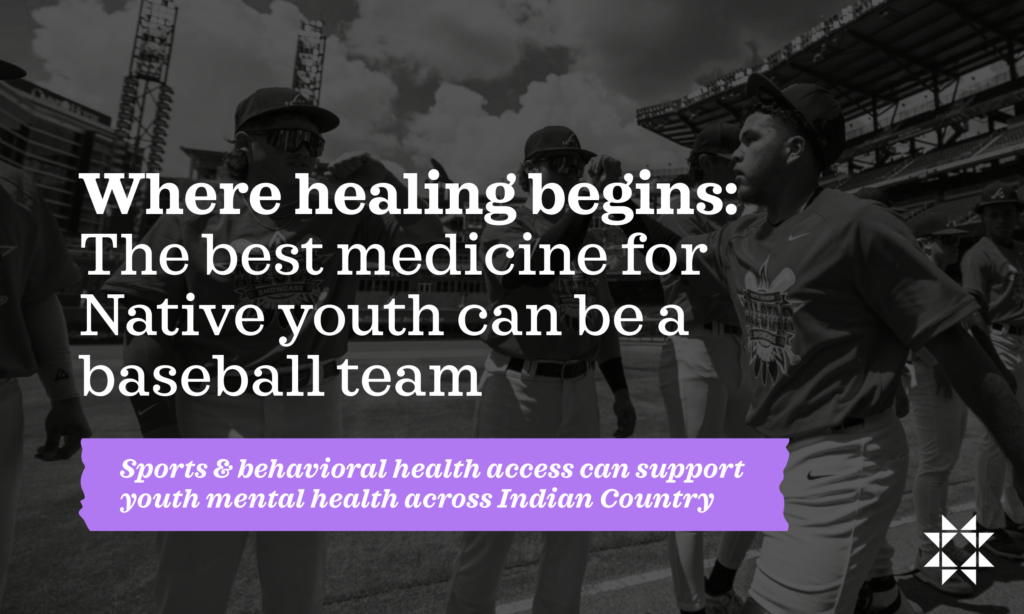

Sports & behavioral health access can support youth mental health across Indian Country
On Sunday, June 28, the top high school baseball players of Native American descent take the field at the 5th Annual Native American All-Star Baseball Showcase. Hosted by the Native American Athletic Foundation, this showcase puts Native talent on center stage for college and pro scouts and lets the next class of young players realize the same path is open to them.
Held at Truist Park, home of the Atlanta Braves, the game will be broadcast on the First Nations Experience Network (FNX) nationwide, and Indigenous Pact is a proud sponsor.
Our mission is health equity for American Indians and Alaska Natives in one generation, so the mental, physical, and spiritual well-being of these athletes is part of the generational promise we work so hard towards. Plus, sports like baseball keep young people physically healthy, and the benefits to their mental health are just as real. Sponsoring the showcase is one way to stand with them, their families, and the Tribal communities already leading the charge.
Why Sports & Mental Health Are Connected
For young people, sports and mental health are closely tied. Team sports give young people a place to belong, a rhythm of practice, healthy movement, and trusted adults who can notice when they need support. These are evidence-based protective factors for mental health, and they help youth feel seen, supported, and connected.
The research backs this up. One large analysis of US youth found that children who played team sports were less likely to show signs of anxiety, depression, and withdrawal than those who did not. A separate study that followed students from middle school into adulthood linked school sports to lower depression, lower stress, and better self-rated mental health years later.
That’s why sports are rarely only about competition or raw talent or a love of the game. What makes a team work is that it asks something of a young person every day, and gives something back. Showing up to practice when you would rather not, being counted on by teammates, getting a little better at something over a season, these build the kind of confidence that holds up off the field. A coach who notices you had an off day, a teammate who saves you a seat, these are small things, but for a young person carrying stress at home or at school, they can be the steadiest part of the week.
"Our youth are our future healers, the ones who carry our traditions forward. Sports are one way to keep them connected to their community and the culture around them. When we invest here, we are building healthy communities and healthy connections for generations."
Cynthia E. Guzmán, PhD, MSCP
Taíno | VP, Clinical Program Development
The connection runs both ways. When a young person is dealing with anxiety, depression, grief, or pressure at home, it often shows up first on the field, in how they play, how they treat teammates, and whether they keep coming back. A coach or a teammate is frequently the first to notice, and sports can be one of the easier places to start a hard conversation.
It is one reason a youth showcase matters: events like this build confidence, connect young people with mentors, and reinforce the habits that keep them well.
Challenges Beyond the Game
Young people often turn to sports to bring a sense of belonging when they face challenges off the field. In some Native communities, mental health has been hard to talk about openly, at home and in the community, and that silence can keep young people from asking for help. American Indian and Alaska Native youth also carry a higher risk, with greater rates of mental health struggles and among the highest suicide rates of any group. The bonds young people build through sport are one real protection against that.
But those realities do not tell the full story. Native communities have looked after the well-being of their young people for generations, through family, culture, ceremony, and connection. Researchers increasingly frame these strengths as resilience, considering them a powerful combination of protective factors that support health through an Indigenous lens. In practice, that can look like a young person who knows their language, has elders to turn to, takes part in ceremony, and feels sure of where they come from. Those connections give a young person something steady to stand on when life gets hard.
Sports have long been part of that. Native-led organizations like the Native American Athletic Foundation and Notah Begay III Foundation have used sports and physical activity to strengthen the health of Native youth for years. And culture itself supports health: cultural connections are increasingly shown as a protective factor for the health of Indigenous peoples worldwide. The work now is to pair that strength with access to care that meets young people where they already are.
For Native youth, wellness is strengthened by culture, family, community, and identity. We partner with Tribal communities to expand trusted access to care that respects those strengths, then build it around the people and places a young person already knows.
If you or someone you know is struggling, the 988 Suicide and Crisis Lifeline offers free, confidential support, 24/7.
Access Should Not Depend on Zip Code
A young person’s access to mental health support, or any healthcare, should not depend on where they live, what their family earns, or what insurance they carry. The reality is that many rural and reservation communities work against real barriers to specialists, including behavioral health providers. Families are forced to drive hours, or to rely on telehealth that few can use because of infrastructure gaps like broadband or technology access.
Behavioral health is one of the most urgent needs in Indian Country. Families in rural and reservation communities often face long travel distances, limited provider availability, and delays in getting mental health support for their children. When those barriers are removed, care can happen earlier, closer to home, and in partnership with the trusted people and places already surrounding the young person.
We partner with Tribal communities to bring specialty care of all kinds, including behavioral health, into the places people already know and trust, through our Tribal Care work and OneRoom’s immersive care technology. Tribal-led models have shown that when care is designed by and for the community, people (including youth) engage with it more readily. So, if a partner has a specific focus on the health of their youth, we work with them to expand services or bring in new specialists, whether that is in the clinic, in schools, or somewhere else in the community.
Bringing specialty care directly to your people through bold, Tribal-led innovation.
Why Indigenous Pact Shows Up
The athletes on the field this weekend show what is possible when a community invests in its youth, in their minds, bodies, and spirits. We are proud to back Native excellence because we want these players to have what they need, on the field and off it. Support, belonging, somewhere to put in the work: these grow strong players, and they help young people stay healthy too. We’ll be here to keep building that care alongside Tribal communities long after the game ends.
- Brayden Allen — Chickahominy Indian Tribe
- David Anderson — Grand Traverse Band of Ottawa & Chippewa Indians
- Mackaden Arthur — Navajo
- Duane Ayze — Diné/Navajo
- Bryce Barnoski — Cherokee Nation
- Eli Beck — Cherokee
- Luke Benitz — Gros Ventre
- Aiden Cooper — Creek (Muscogee)
- Kollin Davis — Choctaw
- Truth Dedmon — Cherokee
- Conner Ellis — Potawatomi
- Taden Fine — Cherokee/Creek
- Grant Fitzgerald — Choctaw
- Bradley Froman — Onondaga Clear Sky (Six Nations)
- Emiliano Garcia — Eastern Band of Cherokee Indians
- Maverick Gardner — Choctaw
- Aiden Graves — Red Lake Band of Chippewa
- Sam Hatcher — Osage Tribe
- Tayvian Hawk — Crow Creek Sioux Tribe
- Ty Hemenway — Cherokee
- Sanjiya Hickman — Mississippi Band of Choctaw Indians
- Jefferson Hodge — Choctaw
- Ronald Jones III — Cherokee
- Eric Keesis — Prairie Band Potawatomi Nation
- Rajon Kenton — White Mountain Apache Tribe
- Malachi Large — Eastern Shoshone and Comanche
- Kamden Martin — Poarch Band of Creek Indians
- Michael Moon-Manzi — Bear River Band of Rohnerville Rancheria
- Michael Navarro — Round Valley Indian Tribes
- Nicky Navarro — Round Valley Indian Tribes
- Kekoanui Payanal — Native Hawaiian
- Salvador Pedroza — Round Valley Indian Tribes
- James Weston Randolph — Citizen Potawatomi Nation
- Ryker Robinett — Puyallup Tribe of Indians
- Talan Rush — Cherokee
- Kevin Sam Jr. — Navajo
- Crayton Sapp — Cherokee
- Madden Sawyer — Choctaw Nation
- Cooper Smith — Oneida (Wisconsin)
- Will Talburt — Cherokee
- Kaden Thomas — Choctaw Nation
- Isaac Tsonetokoy — Kiowa Tribe of Oklahoma
- Cody Two Bulls — Oglala Sioux Tribe
- Ian Velasquez — Chiricahua
- Anselm Wasinger — Cherokee and Delaware
- Amir Woodie — Navajo
- Mason Yazzie — Navajo
Indigenous Pact is a proud sponsor of the 2026 Native American All-Star Baseball Showcase